Facebook

Showing posts with label Injinji. Show all posts

Friday, October 13, 2023

The Adventure of A Lifetime (G2G race report) - Part 1

Intro

I have taken a slightly different approach to this race report because of the shear volume of information I'm sharing. While I could make this one HUGE write-up, I decided to provide some general narration of the event from a higher level and then split out the details of each stage into a different post.

Click here for Part 2 (stage details)

Butterflies

Check in nerves
Preparing for a race like Grand to Grand (G2G) is the kind of adventure that feeds my analytical engineering soul. I must have checked and rechecked my spreadsheets, trackers and rule book 200 times leading up to the race check in. I have also packed and re-packed my gear to make sure (1) it all fits and (2) it weighs a "reasonable" amount (21-24 lbs is considered "reasonable").

I've invested well in ultralight camping gear and supplies so I had no worries there. It was honestly worried about the food. Would I have enough? I arrived in Kanab with nearly 15 lbs of food before making 2 cuts and weighing in at 13 lbs for check in. I was advised by the RD's to be even MORE critical of my nutrition and weight before getting to the start line. The minimum weight requirement for the race is 7.7 lbs - I would come in just over 10 lbs for 7 days and I was truly concerned that it wouldn't be enough.

I was truly more nervous about the gear check-in than actually toeing the start line. Did I forget something? Have I made good fueling choices for all the stages? Did I label everything as required? Long adventures like this can be completely deflated by a single bad choice and even though I had planned for most scenarios, you just never know how the day is going to go...let alone a week.

A "Bumpy" Start

It felt great to finally be loading onto the buses to take us out to Camp 1. We were provided a nice sack lunch before boarding knowing that it would be 1.5-2 hours drive to the edge of the Grand Canyon starting line. It was a fairly tight squeeze trying to get warm bodies and our 20 lb packs into a single passenger van. Most everyone sat uncomfortably squished with their packs on their laps for the entirety of the trip. It was particularly harsh as we transitioned to the country road which was anything but smooth. Uncomfortable grins, low guttural moans and heavy sighs were the norm for about an hour as we (in the back seat) endured every single bump like kids catching air in the back of the school bus. It wasn't very pleasant.

As the white tents came into view, so did the amazing views of the Grand Canyon. It's hard not to be impressed with the scale and majesty of millions of years of geologic forces at work. Between getting oriented at our tents, making introductions to new friends/tent-mates and wandering out to the edge of the Grand Canyon for photos, no one was really paying attention to the clouds that were slowly rolling up to our camp.

Sprinkles and low clouds turned into the tent-shaking gusts of a full storm system that would relegate everyone into their tents for about 45 minutes. It was actually cool being forced to sit down with new faces and friends to learn who you'd be spending the week with.

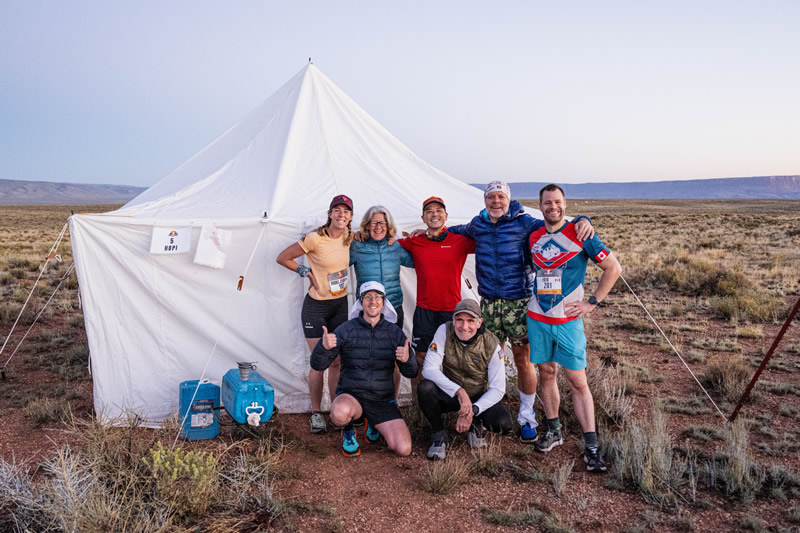
The tent 5 (Hopi) residents were:
  • Brooke (USA)
  • Joanne (AUS)
  • Ryan (UK)
  • Nick (UK)
  • Erik (CAD)
  • Patrick (USA)
Tent 5: Hopi

The GC!

Race briefing
Start line on the GC

Eventually, the storm would subside allowing everyone to gather for a nice dinner and short race briefing overlooking the Grand Canyon. The sunset would help ease all the nervous energy at camp and eventually everyone would hunker down in their tents to start preparing for the 8 am start time.

The Journey

In my opinion, journeys like this require a routine that helps not only maintain your sanity but keeps your body in tune with what you're trying to accomplish. From the start of the race, I did my best to keep a routine as close to real life as possible and ensure my exertion was well within the boundaries of my training. What does that really look like?
  1. 6 am wake up, then coffee (no breakfast)!
  2. Change into race clothes, re-pack gear
  3. Begin racing at 8 am
  4. (Back at camp) Wipe down, clean up, wash/rinse clothes
  5. (optional medical tent visit)
  6. Recovery drink/hydrate, stretch and unwind
  7. Eat dinner, hydrate
  8. Prep pack for next stage
  9. Go to bed ~7:30/8
  10. (wake up around 3 to pee) 😜
  11. Repeat for 7 days
I feel extremely fortunate to have met Ryan after starting Stage 1. Our paces, race strategy and outlook were very much aligned as first-time stage racers. Having a buddy for something like this was extremely beneficial both physically and mentally. We pushed each other throughout the day and ended up staying together the entire race. Our celebrity couple status was firmly cemented by the checkpoint volunteers - "Tryan" become a G2G household name!

Team 'Tryan'

Overall, the daily miles clicked away without much incident. Vespa remained the cornerstone of my fueling strategy and was the exact right thing under these conditions (my podcast interview with The Juniper Lab goes into more detail on this). Yes, the terrain we navigated was quite difficult in multiple respects but in my opinion, the most challenging element was the heat of the high desert. I initially thought that my summer training in Phoenix (low-desert) would hold up against the forecasted 85 F high temps but the high-desert sun definitely added to the toughness of the first 4 stages. My calves were sunburned at the end of Stage 2 and I knew I needed to fix this or other problems would arise so I re-purposed my arm sleeves into leggings! They worked wonderfully as protection from the thorny things as well as an extra layer of sunblock. Crisis averted.

Arm sleeves converted to leggings 🤦🏽‍♂️

The only other notable "incident" for me was about half-way through Stage 5 when I stepped off the trail to go pee.
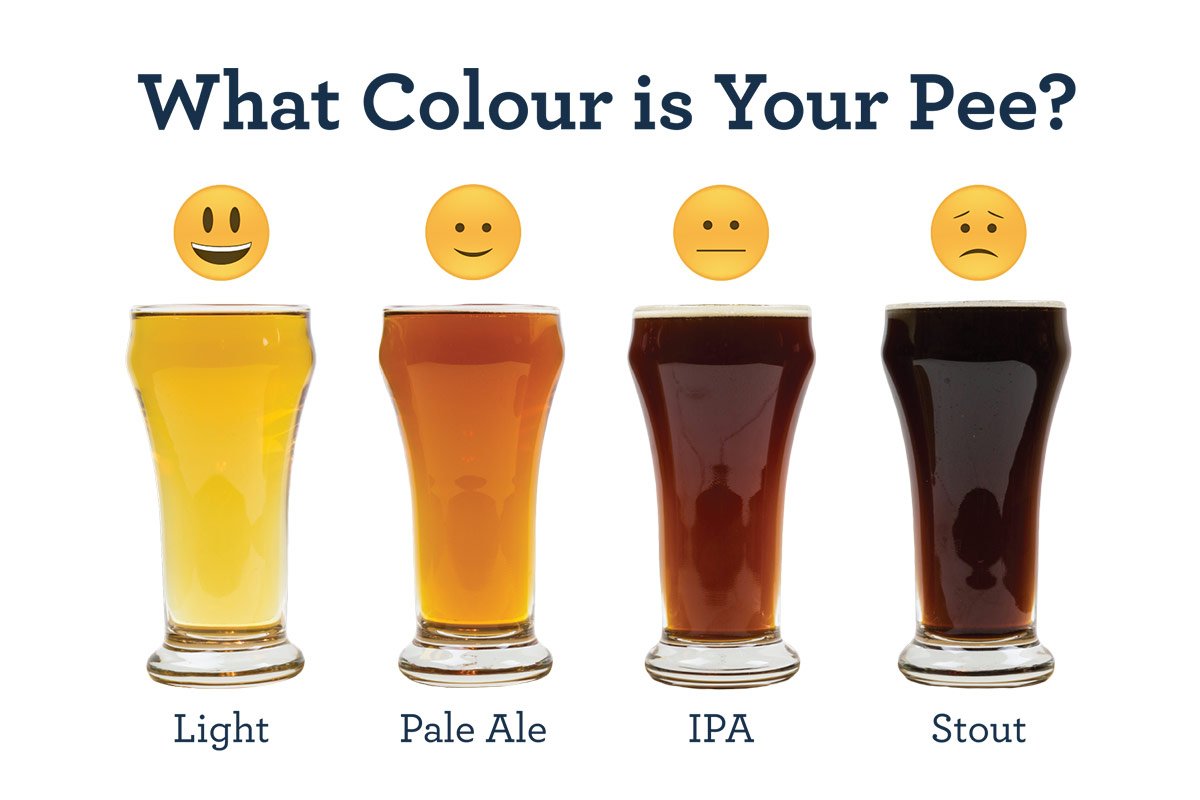
I peed a Guinness (stout) 😬 which is not good. I immediately started drinking what water I had left (~1 L) until I got to the next check point, filled my bottles and drank those down (1.5 L) before crossing the finish line for the day. I then had 0.75L of recovery drink, followed by another 1.5 L of water before dinner. I typically stop drinking water after dinner because I know I'll have to pee all night but in this case, I made sure to have another 0.75 L before bed. If you're not good at the math, that's nearly 6 liters of water over the course of 6 hours. I did not pee again until approximately 4 am that morning 🤯 I was happy that I caught up on my hydration but also kicking myself for getting that far behind...

Remember, if you're looking for details about each stage, click over to Part 2. It's about to get sappy...

The Climb

Despite being physically prepared for this race, the thing I was honestly not prepared for was the emotional impact it would leave on me. There is something about the community and friendships that are formed from these days of mutual success and struggle. It's easy to say that adversity creates a common bond but this race goes beyond that...

Finish line feels

Various folks were racing for various reasons and they're not always what you think. The Jar of Hope gang races for kids with MS. A tent-mate was racing for her mom who passed last year. Even if you're running only for yourself, you can't help be moved by these inspirational people and their stories.

<over-sharing starts>
My personal emotions cracked the morning of Stage 5 while sitting on the toilet (of all places). The morning music playlist had been updated to include "Over the rainbow" which instantly reminded me of my mother (who passed away almost 2 years ago). For whatever reason, I was overwhelmed with emotion and needed a few minutes to collect myself before heading back to the tent. Mom always worried about me going on crazy runs or adventures but I know she would be enthralled and amazed at what I was doing over this week. I miss her every day 🥰
</over-sharing ends>

There are no petty differences during the week. No drama. Race, ethnicity and job titles don't mean shit at camp or on the course. Daily banter consists of (a) how shitty the sand was, (b) how many blisters you have (c) what's for dinner and (d) how shitty the sand was 😜 lol. Everyone is invested in everyone from the very start and I love that feeling and camaraderie.


Angela at the finish line


Congrats from Ahmed

David and Anthony


Kim crossing the finish line


Stage 1 head nods eventually turn to high-fives. High-fives turn to hugs. Hugs turn into finish line tears with people you just met a week ago.

Physically hard? Yes.
Emotionally captivating? Yes.
A forever family? Absolutely.

A couple weeks later, my physical issues are slowly fading away but the emotional connection I have to this race/adventure/experience continues to linger. I can't help but look at all the pictures of my new friends and finishers. I hope to see them again in the future ❤️ Congratulations to everyone.

Frequently Asked Questions

Friends, family and other athletes have asked many of the same questions over the last week so I figured why not write them down? 

Why did you do this?

Endurance athletes like myself are always looking for the next challenge - the next hardest thing. Stage racing combines several of my passions - camping, hiking, backpacking and ultra-running to places/views where only your feet can take you. G2G is one of those "local" opportunities that not only checks all my boxes but traverses landscapes that very few people will get to see in their lifetime.

Will you do it again?

Given the positive experience, community vibe and overall good time I had meeting people and doing what I love...yeah, I could see myself doing something like this again. There are plenty of stage races around the world that I love to try but I hope I'm not let down by comparison. G2G has set a high bar!

Are you crazy?

We all have a little bit of crazy brewing inside us - it's just a question of how you channel it. Ultra-running is not just something you jump into. It takes years of patience, training and gradually being able to wrap your head around the solidarity and time it takes to accomplish these distances.

Did you have fun?

Yes. I love adventuring. I also love the community that comes with collective success and suffering. I have never "felt" a race like this before - the family that's created over the course of a week is truly unique and something I'll carry with me for the rest of my life.

What was the hardest part?

Specific to racing, the relentless sand of G2G is a doozy. It gets everywhere and is super-annoying (especially the dunes). However, even if you don't have the opportunity to train in the sand, you can effectively run/hike if you know how to navigate it. Alternatively, the hardest part (especially for a first-time stage racer) is the acquisition and inventory of gear, planning your nutrition and testing EVERYTHING prior to the race.

What did you enjoy the most?

Aside from the stunning visual landscapes, the community of people that come together for this event is truly magical. Athletes, volunteers, physicians, civil servants and race directors do everything in their power to get you to that finish line.

Gear List

Numerous folks at the race this year asked about my gear so I've captured the primary items below. It's also a nice intro for folks who are looking at this race in the future - supported or self-supported, your gear choices are meaningful both for your comfort AND weight in your pack. 

  • Running Gear
    • Pack: USWE Hajker Ultra 30L
    • Shirt: Montane Dart Lite
    • Shorts (base): 2XU core compression
    • Shorts (outer): Nike Stride
    • Poles: Leki FX.Superlite
    • Shoe: Hoka Speedgoat
    • Socks: Injinji mid-weight trail
    • Gaiters: Awksports shoe covers
  • Nutrition
    • Vespa
    • Gels: VFuel
    • Electrolyte: First Endurance EFS
    • Dinners: Pinnacle Foods
  • Camping gear
    • Sleeping bag: REI Magma 30
    • Pad (inflatable): Therma-a-rest Neoair Uberlite
    • Pad (base): Gossamer Gear thinlite
    • Shoes: Xero aqua cloud sandals
    • Pants: Patagonia Terregonne jogger pants
    • Top: Rabbit Deflector
    • Jacket: Feathered Friends Eos
Don't forget, there's more of the story in Part 2!!

The Adventure of A Lifetime (G2G race report) - Part 2

Overview

My strategy going into G2G was to hike 60-75% of the time and run the downhills and/or flats when it felt reasonable. I gave myself some grace on the first couple stages knowing that I'd be experiencing various things physically and mentally. Turns out, I would learn some valuable lessons on packing my bag as well.

I was not expecting as much sand quite honestly. Deep. Fine. Sand. EVERYWHERE.

I did not train one minute in sand during the summer but I've run in enough sand to know how to do it efficiently. I think this combined with the right shoe choice (Hoka Speedgoats), socks and poles were a couple of the key elements for successfully navigating the true sandy deserts of Arizona and Utah.

My #1 tip? Do not stew over the total miles (for the race or stage). Focus only on the miles for the day and hone in on whatever it takes to get from checkpoint to checkpoint. Every checkpoint has information posted on the distance to the next checkpoint. Focus only on that!! You'll find the miles melting away quickly and you can revel in the energy and excitement of the checkpoint volunteers.

Don't skip Part 1 - read the overview here. In Part 2 I've tried to recall the things that were meaningful to me during these stages without ruining the experience for future participants. Enjoy!

Stage 1

Distance: 30.8 miles / 49.6 km
Stage Time: 8:53:15
Standing (Stage 1): 17 overall / 11th male

My goal was to take it easy out of the gate and let the adrenaline pass over me to ensure a consistent and steady baseline for this 50k. My memorable moments of this stage include:
  • The JAR of Hope crew doing pushups at the starting line
  • The LeAnn Rimes rendition of the national anthem
  • Connecting on course with Ryan
  • Pausing at checkpoint #1 to (1) tape my lower back and (2) cut the (brief) liner out of my Nike shorts
This stage is relatively flat and a mix of soft track sand and hard packed sand. It was fully exposed and required traversing a few stretches of desert vegetation full of cacti, native grasses, creosote bushes and Russian thistle.

There is a mood of general excitement but that slowly dissipates as the sun comes out, packs start to settle and idea of a 50k Stage 1 begins to sink in.

Pro tips: (1) Reign in your adrenaline and run as much as you're comfortable. (2) Concentrate on looking down more than looking up. One wrong step and you can end your race with cacti needles in your toes. (3) Gaiters are not necessary for this stage.

Stage 2

Distance: 26.9 miles / 43.3 km
Stage Time: 8:18:34
Standing (Stage 2): 9th place / 5th male

The onslaught of desert vegetation, cacti and fence lines continues in this stage. You'll need to hone your sighting skills to find the flags amongst the bushes, cacti and fence lines but depending on the summer weather, you may or may not need protection for your legs or gaiters. The climbing and descending were a welcome change from Stage 1 - definitely 2 of my favorite things! The last 6 miles were pretty brutal due to the overgrowth of Russian thistle scraping my shins.


Pro tips: (1) Continue to focus on what's at your feet over what's in the distance. Cacti needles will ruin your day. (2) Enjoy the downhill if can. (3) Calf sleeves and gaiters are not a bad idea for this stage but you can get by without them.

Stage 3

Distance: 53.2 miles / 85.4 km
Stage Time: 18:54:23
Standing (Stage 3): 6th place / 4th male

The long stage is (apparently) what separates the wheat from the chaff at G2G. The highest percentage of drops occur before Stage 3 and yet, the finish rate for those that complete Stage 3 is 99+%. Pretty amazing.


It is every bit as hard as you might imagine. With 5,000' of climbing with predominantly deep sand everywhere you go, pacing, hydration and nutrition play a key part in getting you through this stage. I chose not to wear my gaiters until CP6 (right before the dunes) and that did result in some blisters/hot spots on my feet during/after this stage. I think they were a function of the hiking/walking motion over a longer duration of time. I'm pleased with how my Injinji toe socks performed during the race but especially during this stage.

Memorable moments:
  • Bob's badass playlist at CP3
  • The pet cemetery
  • Climbing the coral sand dunes under a full moon
  • Glowing cow eyes
  • Laying in my tent fading in and out of consciousness around 5 am while eating cold Thai green Currey for breakfast
  • Chugging a can of Coke that evening
  • Enjoying not 1, but 2 s'mores in celebration of the 10th G2G anniversary

Pro tips: (1) Treat this stage more like a 100km. Be ready to spend 16-30 hours on your feet. (2) Keep a level head on the dunes. It's easy to get frustrated but patience and pace are key. (3) Use the highest setting on your headlamp after the dunes to more easily sight the course markers. (4) The weather, fatigue and your endurance will determine whether you sleep at CP 6, 7 or 8. I recommend to keep moving through the night so you don't have to deal with additional sun/heat of the next day.

Stage 4

Distance: 26.0 miles / 41.9 km
Stage Time: 7:07:05
Standing (Stage 4): 7th place / 5th male

This stage is net downhill and it's quite interesting to see the mood in camp shift in such a positive way. The notion of doing "just" a marathon is utterly insane coming off a 53 mi Stage 3. Comparatively however, this stage was an absolute pleasure. There is a nice climb soon after the start and you make your way into some beautiful wooded areas but eventually find yourself in more sandy track enjoying the net downhill miles of this stage.


Pro tips: (1) Enjoy the cooler temps as you start to gain elevation. (2) Take advantage of (e.g., run) as much of the flat and downhill as possible. (3) Embrace the confidence of finishing stage 3 - a marathon is easy by comparison!

Stage 5

Distance: 26.3 miles / 42.2 km
Stage Time: 7:48:09
Standing (Stage 5): 13th place / 8th male

This day proved to be the hardest stage mentally for me despite the "wow" factor of the slot canyon and other natural geologic wonders you'll experience in the first couple hours. Once this wears off and the remainder of the day sets in, you're left with a fair amount of climbing (~3,200') to get to camp. Of course, those miles are a mix of sand, gravel, cross-country vegetation and lava fields.

I apologized to Ryan that day because I was intensely focused on just getting through the miles. Like an old married couple, we didn't talk much that day. A few groans, grunts and swear words perhaps but it was obvious we were both struggling with the monotony of the miles, nutrition choices and the incessant sandy track. The notion of 'just being done' had surfaced as well, which happily launched us into that foreshadowing conversation of 'what's the first thing you're going to eat/drink?' when we cross the finish line tomorrow...

Pro tips: (1) Stop and enjoy the scenery (slot canyons, general geology and colors). (2) Navigate carefully and observe all the race flags and wrong way signs. (3) Be safe and mentally sharp as you navigate the rocky climbs and lava fields.

Stage 6

Distance: 7.9 miles / 12.7 km
Stage Time: 1:40:19
Standing (Stage 6): 9th place / 8th male

It's brilliant to stagger the start times for the last day. The slower-paced athletes leave first and the leaders leave last. This way, you get to see nearly everyone come through the finish line. Ryan and I were mid-pack and got to leave at 9:30 am. We both had some issues flare up overnight but at this stage of the race, you're pretty much on auto-pilot and ignoring anything that hurts. Your pack is the lightest it's been all week and in your head, you equate the miles to some familiar loop or route you know back home...easy-peasy!

We did not pass many people during this stage - the adrenaline is high and everyone can smell that finish line. The mostly hard-packed road makes this stage highly runnable but there are some decent climbs to crush before you can enjoy the downhill.

I found a certain irony that I had not fallen, tripped or wiped out for an entire week but managed to trip on a branch in the last 400 meters to the finish line. Ugh! Thank goodness no one has it on video!

The finish line is pure emotion and exhaustion. Families. Friends. Athletes. Volunteers. Race directors. Photographers. All the people that have invested in you and your success were there to celebrate the achievement. I truly love this G2G family and definitely can see myself being out there again (likely, as a volunteer first!).


Pro tips: (1) Revel in the final miles but don't do anything stupid! (2) Don't hold back the pride and enormity of your success. You are a BFD (big fucking deal!)

Overall

Distance: 171 mi / 275 km
Time: 52: 41:45
Standing: 7th OA / 4th male OA / 1st AG (50-59)


I never had any intention of placing or trying to podium. It was always about the finish line. Reflecting back however, I've always felt that stage racing is the perfect synthesis of the things I love the most and am actually good at when it comes to endurance sports. A strong and stable mental outlook comes with a consistent nutrition strategy...something I've worked really hard at over the last couple years. Training in the desert and summer heat definitely has its advantages as well.


I am humble enough to be surprised (and thankful!) at my place overall but reflecting on all the elements that go into having a solid race, I have the confidence to say I knew what I was doing, had trained well AND had the necessary daily routine to keep me fresh, happy and mentally strong.

Old guys kick ass! 😏

Grateful

I can't thank Tess and Collin for the opportunity to be a part of this family and for creating Grand to Grand. They put on a helluva race. All the volunteers, medical staff and camp crew were completely awesome. I still have not come down off this cloud and continue to connect with many of those athletes in our 'graduating class'. I'm extremely thankful for their unconditional support and friendship. There are some badass humans out there and I watched them do amazing things.


Wednesday, November 21, 2012

Review: Injinji toesocks

I'm a huge fan of Injinji socks and recently wrote up a review for www.trailrunningclub.com - you should check it out when you have a few minutes!

Injinji: Fear Not the Toesocks

Sunday, January 8, 2012

Injinji sock review

Given that I have been out of commission for the last couple weeks, I have not had a chance to try much of my new gear.

The one thing I can review however, is my Injinji socks.

Last year at the PF Change Marathon, I caught a glimpse of April's Injinji socks for the first time. I might have initially pointed and laughed at her feet but she insisted that they were the best around and great for preventing blisters (between the toes).

Having this same problem for many years, I was willing to give them a whirl. They're not cheap mind you - they average about $12-$16 a pair. You won't find them at Foot Locker, Sports Chalet or Dick's. You'll have to find a local running shop or just order them online (Backcountry.com or runningwarehouse.com).

I have been running with the Outdoor crew and Performance Mini-crew for over a year now. I recently purchased the midweight mini-crew. Originally, only those folks who picked up on the Vibram-craze purchased these socks. They're perfect for the five-finger shoe. Over time however, casual runners have begun to see the benefits of a more breathable sock that helps prevent blisters during those long runs.

Overall, Injinji's take a little while to get comfortable with. As with many products, they are standardized for the masses. If you're someone who has Piggy's that are kind of short or unconventionally long, you may have a challenge fitting into these.

The initial weirdness of having something between your toes is temporary in my opinion and fades quickly once you get running. You may get some hot spots but having a hot spot where you used to get a blister is a welcome relief. It is possible to put these on too tightly also. I experienced several runs where he crease between my toes kept rubbing during my (trail) run and caused some blisters.

I love that there are no seams throughout this sock. My blister problem used to occur either on the top of my toes (under the top seam at the toe) or under my toes, where the material would bunch up the farther I ran. I also like that they have an additional band of elastic around the top to prevent rogue pebbles or

I have a few comments about each below.

Outdoor Crew (NuWool)
This sock is best for hiking and/or trail running. They are a blend of NuWool, Nylon and Lycra. These are super-comfortable and plush. With wool as the primary fiber, they stay cool and wick moisture really well. The only downside to this sock is that they wear 'faster' than the Performance mini-crew. Reviewers have complained that the wool balls up after washing and drying but I personally wash them on gentle and dry them on medium-low heat. The only wear I've had is due to use. My tip: Once you start to feel hot spots, it's time to replace them.


Performance Mini-crew
This sock is suitable for road running. The Injinji site lists them as a liner or a lightweight running sock but you could easily use them for everyday running.They are a blend of CoolMax fibers, Nylon and Lycra. They have not worn as fast as the NuWool but then again, don't provide a cushy ride like the NuWool does.


Midweight Mini-crew
This is my new favorite sock for road running. Listed as a mid-weight running and multi-sport sock, it has more cushion and support for the arch and heel ensuring better compression and movement. I wore these today for the first time and appreciated the cushion but didn't feel like the sock was too thick for my shoes. This feels the most like a traditional sock.


I'm sold on Injinji's. I use them for both training and racing. The NuWool for trail and the performance series for road and/or packed trail runs. I would recommend them to anyone who is looking for a better 'ride' or looking to solve their blister problem. Since wearing them, I have only had a couple blisters. I ran the Black Hills 100 (50 mile race) in these socks and did not have any blisters.

5 out of 5 stars.

Look for additional reviews on the products below coming soon.

Monday, June 27, 2011

Black Hills 100 Race Report

Let's just start out by saying, there is nothing easy about running 50 miles with more than 9,000 feet of elevation gain. I knew this going into the race and had tried to mentally prepare for this but honestly, until your quads are on fire, you're choking down gel packs and/or Powerbar's and every mile feels like an eternity...only then do you really understand the notion of mental-toughness.

Getting to the Start Line
The race itself is a small venue - one of only 2 ultra-marathons held in the Black Hills of South Dakota (Lean Horse Productions does both). Nothing like the 35,000+ people participating in the PF Chang's Marathon. Only 165 show registered for the 100 mile, 100 km and 50 mile races. The oldest participant being 70 - and yes, he ran the 100-miles (think about that next time you want to skip a workout and sit your ass on the couch).

Race Start
After an early wake-up call at 4 am, I drove up to Sturgis, SD to prepare for the 6 am start time. Once at the field, the scene was quite yet jovial - many runners huddling with their support crews - a majority of them preparing for the 100 mile run. There was a certain levity to the group - most of the runners seemed to accept the incredible journey they were about to embark upon and yet others were still in awe of the pure courage (or stupidity, depending on your point of view). While waiting, I managed to snap this photo of this brave soul (I just hope he's supporting cancer awareness or something noble)

Mile 0 to Mile 17
I honestly don't remember much about the first third of the run. After a short burst of energy while leaving the start line (pavement), you start climbing into some of the most scenic areas of the Black Hills I've ever seen. It was the perfect morning and I was completely caught up in the beauty, warmth and energy of the terrain and landscapes across western South Dakota. While the first aid station (mile 5) was abuzz with support crews and cheering sections, that slowly faded away as the herds of runners began to thin out as the climbs got to be more and more rigorous.

Miles 12-15 had us crossing the swollen Elk and Alkali Creeks multiple times. Creeks that are normally a foot deep were engorged with rains from the previous nights. Easily traversed, the water still covered my thighs. Though they were a welcome chill to what was becoming a warm day, it soaked my feet to the bone. I have never been more thankful to be wearing Injinji socks that I was this day. They saved my feet.

The miles seemed to melt away as we approached the first major aid station. Stocked with food and our drop bags, I had resolved to rest and eat anything of substance without making myself sick. Running nutrition is a tricky thing for me. I see these folks snarfing down sandwiches, bananas and baked potatoes but uggh....I don't even normally eat that stuff let alone while running. I guess fuel is fuel, right?

I remember leaving this aid station already tired and considering whether my mojo would hold out another 16 miles before I would see this station again on the way back home. There were many more miles to go.

Miles 17 to Mile 33
The Hills were unrelenting in their gains and terrain - which, oddly enough is what kept my mind off the duress and pain I was starting to get in my hips and gluts. As a short aside, I did my BS and MS of Geological Engineering at SDSM&T in Rapid City. Many of my formidable years were spent hiking and exploring these very same formations - it seemed fitting that my one distraction was trying to remember the names of the formations, their age and chemical properties. I mean, how can you not be inspired by views like this?
There was an unmanned aid station at mile 22 - the last before reaching the turn-around point and starting the return journey. Whether by natural selection or the pure masochistic nature of the race director, the turn-around point was an unrelenting uphill climb that felt like the longest 3 miles of my life. The good news was that the climb was only 2.5 miles...the bad news? The last 1/2 mile was downhill. Forget celebrating the awesomeness of reaching the half-way point. I was swearing to everything holy that I had to turn around and climb back up this hill immediately after reaching the 25-mile mark.

Those 8 miles back to the mile-33 aid station seemed to pass more slowly. I knew that I could make the marathon mileage a reality but everything past mile 31 would be an unknown (50K is my longest race). I was surprised to find out that despite time slowly passing, I was making pretty good time back to the aid station...a benefit of all that climbing was that eventually, gravity would be on my side and bring me back down the mountain(s).

It was about this time that pair #1 of Injinji trail socks (wool) were creating some hot spots that needed to be addressed. The increased downhill running had forced me to deal with the wet socks. I squatted for about 10 minutes to apply some Mole Skin and a fresh pair of Injinji socks. About this same time I came to the realization that I had not stocked my CamelBak appropriately with Roctane or other food stuff. So while I really wanted to avoid looking at my Garmin to see how slowly the mileage was going, I didn't have a choice if I was going to keep fueling appropriately.

Mile 33 to Mile 45
Back at the aid station (same as the one at mile 17), I tried mixing some Perpetuem but my belly wasn't having any of that. Having run short of fuel in those miles leading up to aid station, I focused on getting some protein, salt and calories that would sustain me for a while as just the sight and/or smell of Roctane and Powerbar's was starting to make me ill. As I sat there eating, there were several gentlemen who were figuratively 'waving their white flags' and looking for a ride back to the finish line. It was a harsh reality to hear that folks were bailing - route 89's first victims of the day.

Whether it was testosterone, adrenaline or the handful of M&M's I took on my way out of the aid station, I started to fly (relatively) at a sub-15 minute pace between miles 34 and 38. Despite it being mostly downhill - a nice gradual downhill - I was making good time. It actually felt better to run than to walk - so, I kept running.

I was trying my best to remember landmarks and project where I was. This proved to be a mental no-no because I kept getting let down when I wasn't at the mileage or landmark I expected. Ultimately, this made the last couple miles to mile 40 feel pretty darn long. I was fairly certain that the big aid station was at mile 40 but again, I was let down to find a small folding table with semi-cold water in it.

This was the stage of the race where I knew that I'd finish within the 16-hour window. I kept myself mentally busy the last several miles doing the math and figuring out that I had gone 40 miles in 10 hours. So long as I kept that pace (which I could do walking), I would need another 4 hours to go 10 miles. Turns out, my math is still pretty good :)


There is not much to say about this stage of the race except, "pain". While there is a certain pleasure one might get in running downhill, there is also an exponential amount of pain that hits your quads and knees from all that pounding.

Getting to the aid station at mile 45 was all about managing the hurt. The Injinji socks were holding up well but soggy feet, hot spots and uneven rocky terrain make for tough love on the feet when you're going downhill. These 5 miles were a combination of half-hearted jogging...shuffling...walking just to get to the next aid station. I was force-feeding myself at this stage too. Taking a Roctane every 3 miles was not cutting it. I tried to choke down another PowerBar but it was so dry and nasty that I had to drink 3x the water just to wash it down...

Finally, I made it to the 45-mile aid station. I threw back a couple cups of Coke, watermelon, pretzels and chips but nothing really tasted good enough to keep eating. I refilled the CamelBak with ice water and shuffled on my way. I was still jogging/shuffling at this stage and was filled with the certain satisfaction of knowing that I was almost done. Clearly however, I had forgotten about the terrain I had passed over nearly 13 hours earlier. It was all uphill.

Mile 45 to Finish

The video says it all. One of the most grueling hills lay between mile 45 and the finish. I stopped multiple times on my way up because I thought I was going to toss my cookies. The good news is that I had some mojo in the tank to take me to the top...or what i thought was the top. Dammit, a false flat. When will this hill end?!

At some point, I came upon some girls hiking up the trail and I knew that I had to be close to the trail head that hits the road back to the finish line. It's that moment when I realized what I had done that day. 2 miles seemed insignificant considering what I'd spend 13 hours doing already.

I had hoped to run in to the finish line super-strong like Dean Karnazes or something but clearly, trying to do a 9-minute pace after being on your feet for 14 hours is not so easy. Eventually, I drew closer to the track where we started and ToddG was there calling my name in encouragement. We walked a bit - chit chatted as much as I could after trying to dash to the finish. I rounded the corner to see all my family, kids and friends standing at the finish line. My kids even came through the chute with me.

Unfortunately, I was not very social after crossing the finish line either. I felt bad knowing that all these folks had come out to support me and yet I couldn't stand still or I'd fall over. So I kept walking to try and find some soda or chocolate milk. I eventually found that chocolate milk and then proceeded to toss my cookies. After that, I felt (relatively) good and socialized a little bit more before getting changed and heading home.

My Garmin stats are here but I wouldn't trust anything after mile 45 - the auto-pause feature kept engaging because I was walking so slowly up the hills that it wouldn't stay on.

I have to say, I'm pretty proud of this one.

I left my soul in the Black Hills last weekend. I guess that's as good a place as any to achieve something many folks can only imagine.